
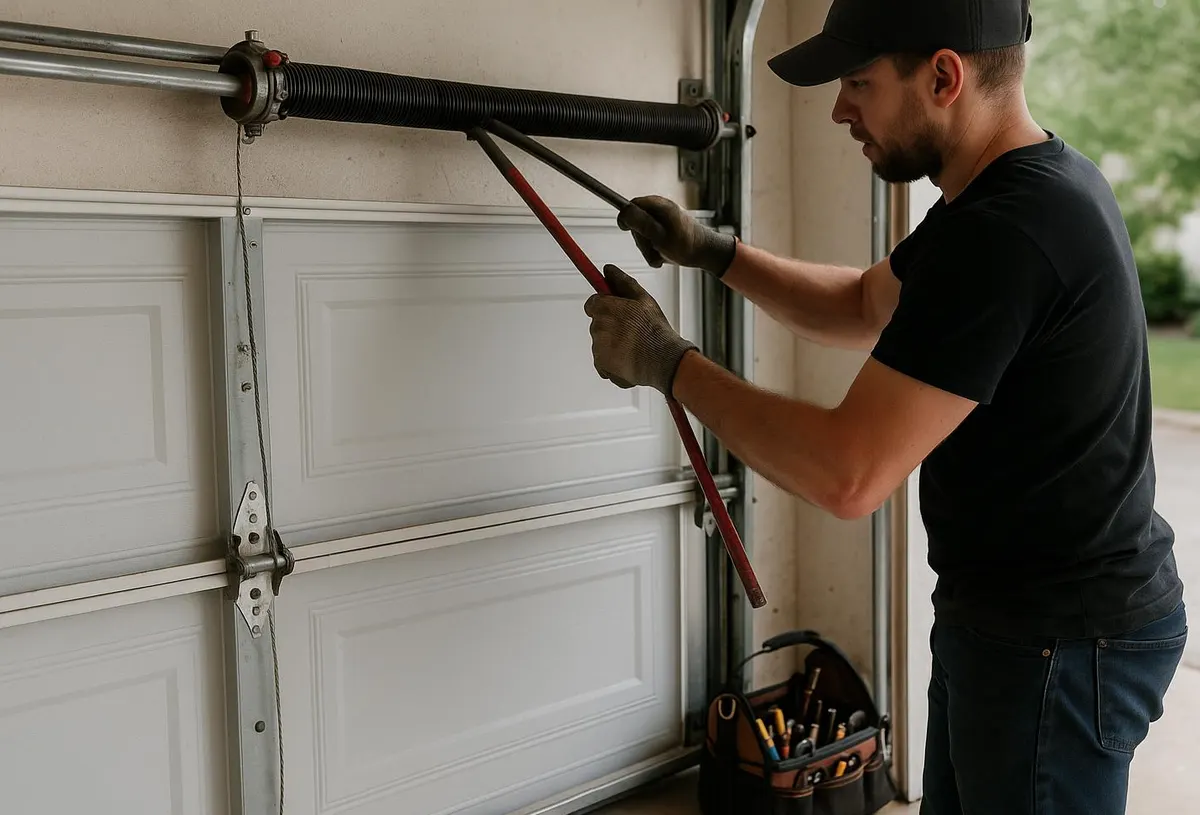
It usually starts with a bang. You're in the kitchen, or outside watering the yard, and you hear a sharp metallic crack from the garage. When you go check, the door either won't budge, or it opens a few inches and stops like something is fighting it. That sound is almost always a torsion or extension spring letting go, and it's one of the most common reasons homeowners call for garage door repair. If this just happened to you, here's what to expect when it comes to cost, and what should be in any quote before you say yes.
What a Spring Replacement Actually Involves
Garage door springs do the heavy lifting. They counterbalance the weight of the door so the opener (or you, lifting by hand) only has to manage a fraction of the actual load. Most residential doors use one of two spring types: torsion springs mounted on a bar above the door, or extension springs that run along the horizontal tracks. Torsion springs are more common on newer installs and tend to last longer, but they also require specialized tools and knowledge to replace safely, since they're under extreme tension.
As a national range, replacing a single torsion spring typically runs about $150 to $350 including parts and labor. Many garage doors, especially heavier ones, use two torsion springs, and replacing a pair usually falls somewhere between $250 and $450. Extension spring replacement tends to run a bit lower, often $100 to $300 for a pair. These are broad national ranges, not a quote, and the number you're given locally can land above or below depending on the factors below.
Factors That Push the Price Up
A few things reliably move the cost higher:
- Door weight and size. Heavier doors, like insulated steel or wood-look composite doors, need higher-tension springs rated for more cycles, which cost more.
- Double-spring systems. If both springs are original equipment and one has broken, a good technician will usually recommend replacing both, since the second is likely close behind. This adds cost upfront but avoids a second service call soon after.
- High-cycle or upgraded springs. Standard springs are often rated for around 10,000 cycles; higher-cycle springs rated for 20,000 to 25,000 cycles cost more but last significantly longer, which matters if the door is used multiple times a day.
- Hardware wear. If the cable drums, bearing plates, or center bracket show wear or rust, replacing them at the same time adds to the bill but prevents another breakdown shortly after.
- After-hours or emergency service. A spring that breaks on a weekend or evening, especially if the car is trapped inside, often carries a premium for same-day or emergency dispatch.
Factors That Can Lower the Price
On the other side, a few things keep costs closer to the low end of the range:
- Standard residential door size and weight. A typical single-car or lightweight double-car door needs less from its springs than an oversized or heavily insulated one.
- Routine replacement, not an emergency call. Scheduling during normal business hours instead of calling for an urgent after-hours fix.
- Good existing hardware. If the drums, cables, and brackets are in solid shape, there's no need to replace extra parts.
- Bundling with a tune-up. Some companies offer a modest discount when spring replacement is paired with a full maintenance check, since the technician is already on-site and inspecting the system.
What a Fair Quote Should Include
A clear, honest quote should spell out more than just a single number. Look for:
- The spring type and size being installed, and whether it's rated for standard or high-cycle use.
- Whether one or both springs are being replaced, and why.
- Any additional hardware included, such as cable drums, bearings, or the center bracket.
- Labor and parts broken out separately, or at least itemized enough that you can see what you're paying for.
- A warranty on both the parts and the labor, with the terms stated plainly.
If a quote is just a flat number with no breakdown, it's worth asking a few questions before agreeing. A company confident in its pricing will walk you through it without hesitation.
Why Climate and House Age Matter Here
Homes in this part of Southern California deal with hot, dry inland summers, dusty conditions, and occasional wildfire smoke, followed by winter rain. That combination of heat cycling and dust buildup can accelerate wear on spring coils and the hardware around them, especially on older systems that haven't had regular lubrication or inspection. Houses that have gone through earthquake retrofitting sometimes have garage door framing or bracing that was adjusted during that work, which is worth mentioning to your technician so they can check that everything is still properly aligned before installing new springs.
When to Call Chino Garage Door
If you've heard that bang, or your door is suddenly heavy, uneven, or won't stay open, it's time to call. Our Garage Door Spring Replacement service includes an on-site inspection of the full system, not just the broken spring, so you're not back to square one in a few months because a worn cable or bracket was overlooked. If your door is older or getting frequent use, we'll also walk you through whether a Garage Door Maintenance & Tune-Up makes sense alongside the repair, since catching worn hardware early is a lot cheaper than an emergency call later.
If your garage door in Chino, CA has gone quiet and heavy, give Chino Garage Door a call. We'll give you a clear, itemized quote and get your door moving safely again.